



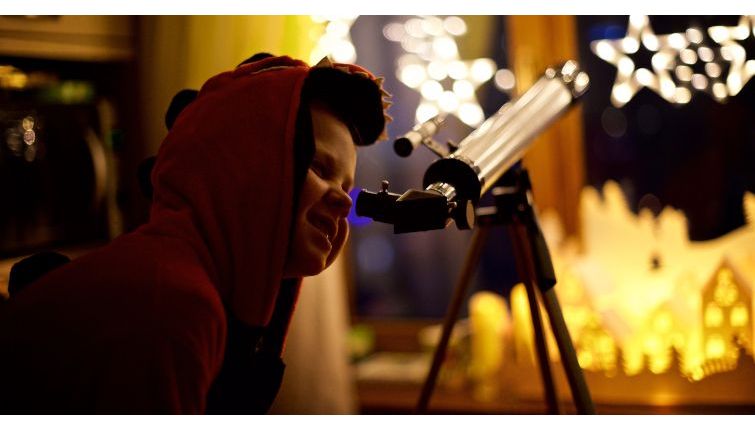
Does your child dream of exploring the stars and discovering the mysteries of the universe? A telescope allows for fascinating stargazing and space exploration and gives both children and adults a new understanding of astronomy. But how does a telescope actually work? And which one of our children’s telescopes is right for you?
We carry beginner telescopes, so your child can figure out whether their passion for astronomy lasts longer than a couple of nights, as well as more advanced models with high magnification. As with microscopes, price and quality tend to go hand in hand.
Here’s a guide to telescopes for children as well as answers to some common questions.
What kinds of telescopes can you buy at ToyAcademy?
Our webshop has telescopes that are particularly suitable for children and beginners. Our selection includes:
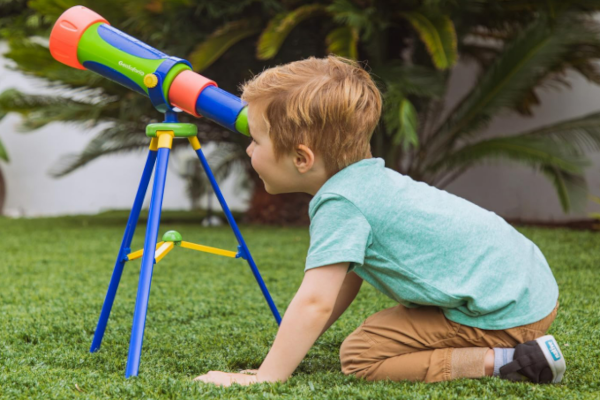
- Telescopes on tripods that can be placed on the floor or the ground
- Compact tabletop telescopes
- Telescopes for stargazing and telescopes for exploring nature during the daytime
- Easy-to-use telescopes that help children learn about optics and celestial bodies in a fun and engaging way
- Very small handheld telescopes
Please note that, no matter which telescope you choose, the tripod is not designed to support the weight of your child leaning on it excessively.
What is a telescope and how does it work?
A telescope is a type of instrument - not a musical instrument, but one that lets you observe objects that are very far away, such as the moon or the stars.
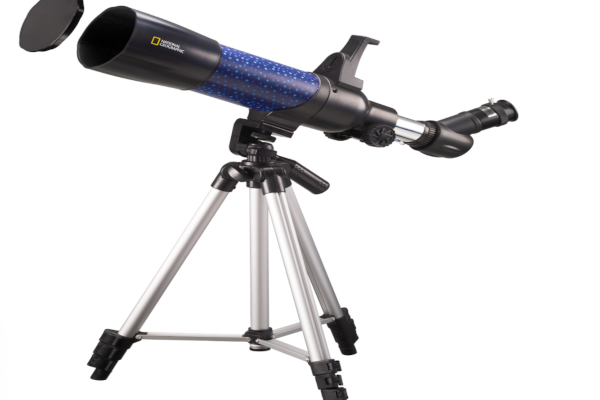
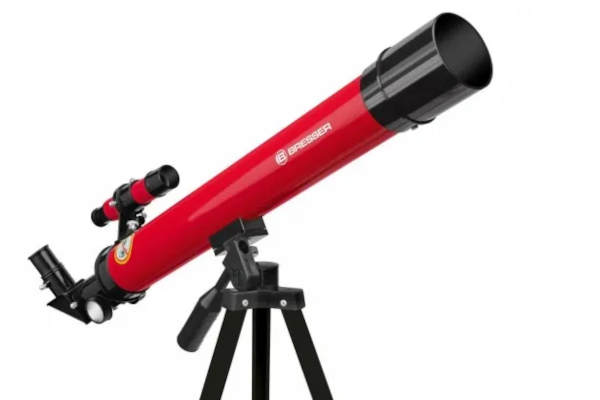
The long tube inside a telescope has mirrors or lenses and is called the optical tube.
A telescope’s optical tube has an objective inside, which can be either a mirror or a lens. The mirrors and lenses are called the optics, and they gather and focus light from distant objects, making them visible. The larger the optics, the more light can enter the telescope - just like in a camera or binoculars. More light gives a higher magnification, so you and your child can see more objects through the telescope.
You look through the telescope via the eyepiece, also called the ocular lens. It’s the eyepiece that provides the magnification, so that looking through your telescope is different than just looking at stuff through a toilet paper tube.
Telescopes often come with several different eyepieces, allowing you to switch between different levels of magnification.
Is higher magnification always better?
The higher the magnification, the more important it is to keep the telescope steady and pointed in exactly the right direction, which can be challenging for children. That’s why we recommend a children’s telescope with a tripod if you want high magnification. Keep in mind that high-magnification telescopes are also heavier than low-magnification telescopes.
We recommend starting with low magnification and then increasing it, so you can focus on your child having a fun, successful experience rather than being able to see every little detail in the night sky right away.
What does 10x or 50x magnification mean?
If a telescope has 10x magnification, it means that an object which is 10 meters away will appear through the telescope as if it’s only 1 meter away. 50x magnification means that if a deer is 50 meters away from you, it will appear through the telescope as if it’s standing just 1 meter from you. With the moon being 384,000 km away, the telescope will make it appear as if it’s only 7,680 km away. So, it’s still quite far away.
How to start stargazing: a beginner’s guide to telescopes
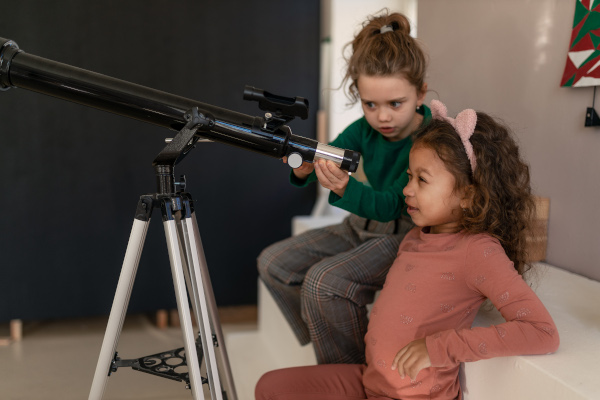
If you haven’t used a telescope before, getting used to it may take some time and practice. Learning how to use a telescope requires fine motor skills, concentration, and patience.
Occasionally, a customer will return a telescope to us because they believe it’s defective. However, when we test the telescope, there’s nothing wrong with it.
So, if you’re having trouble setting up the telescope, we kindly encourage you to try these steps:
- Read the instructions and make sure you assemble the telescope correctly. Maybe you’re the type of person who prefers to assemble things on your own without a manual, but with telescopes it’s crucial that all parts are assembled properly at the correct angles.
- Don’t look at objects that are too far away. Some recommend looking at objects that are 1,000 meters away, but in our experience it’s best to find an object that is about 50–100 meters away from you and practise focusing your telescope on it.
No night sky to be seen: everything is dark when looking through the telescope
If you can’t see anything through the telescope, it may be because:
- The lens cap hasn’t been removed. It’s easy to forget that there’s a cap there you need to take off before use.
- The magnification of your eyepiece is too high. Always start with a low magnification and work your way up. For example, start with 20mm/25mm, and then switch to 10mm. Remember, the lower the number on the eyepiece, the higher the magnification.
How to focus
You adjust the focus by turning the focusing knob on the telescope. If you can’t get a sharp image, try this:
- Start with a low-magnification eyepiece (e.g. 20mm or 25mm), as these are easier to focus. Later on, you can switch to an eyepiece with e.g. 10mm. Remember, the lower the number, the higher the magnification (although it would be easier to remember if it were the other way around).
- Focusing can be much more difficult than you may think, so don’t give up if you can’t focus the telescope on your first couple of tries.
- Practise focusing during daylight hours on objects that are easy to come by, such as trees or buildings.
- If you can’t focus the telescope, try objects at longer or shorter distances.
- Turn the focusing knob slowly until you get a sharp image.
How do I use the telescope’s finder scope?
Some of our telescopes for children have a finder scope mounted on top of the telescope. The finder scope is used to angle the telescope in the right direction. It’s important that the finder scope is perfectly aligned with the telescope itself so that it points in the exact same direction. The finder scope should show the same image as the one you see through the telescope’s eyepiece.
Can we look at the sun through a telescope?
No, looking at the sun through a telescope can cause eye damage just like looking directly at the sun can hurt your eyes.
Can we look at wildlife through a telescope?
You and your child can absolutely look at wildlife and other objects that are far away from you. Just be aware that a refracting telescope (one that uses a lens as its objective) will mirror-reverse the image. And a telescope that uses mirrors will show the image upside down, so it’s really only suitable for looking at planets, the moon, and other objects in the night sky, where it doesn’t really matter if they’re upside down or not.

With a telescope, you and your child can delve into the wonders of astronomy and learn about the moon, the stars, the planets, and maybe even galaxies, in a whole new way. But the adventure will be cut short if you keep having trouble with the telescope, for instance because it’s not assembled properly, or because you need to practise focusing in daylight before you pack your rations and your sleeping bags and head into the wild.
So, we hope this guide has answered your questions, and that you and your child are ready to choose a telescope and start studying the moon or exploring the stars together.
PS: Have you noticed that some of our telescopes come with microscopes?