



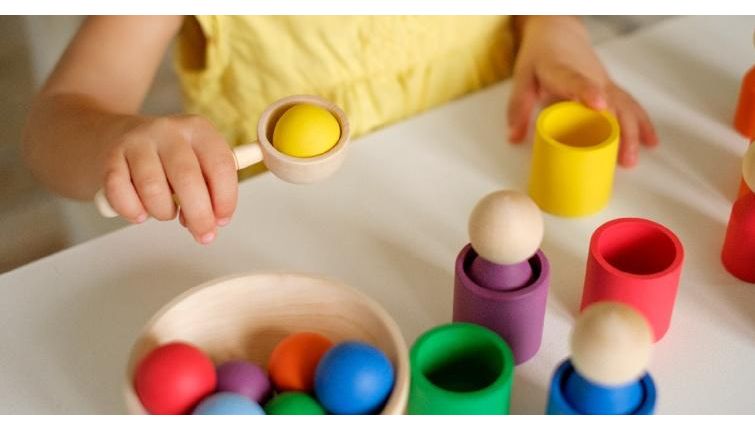
Have you heard of Montessori? Maybe you already know what we’re talking about and don’t even need to keep reading. At ToyAcademy, we only recently discovered the Montessori approach to children’s learning and play - despite the idea being over 100 years old.

If you have no idea who or what Montessori is, we kindly invite you to keep reading.
At the end of this blog post, we’ll share some practical advice on how to create learning environments for your child.
The Montessori approach: An inspiring day at kindergarten
Children are born with amazing developmental potential and a natural desire to learn, and they greatly benefit from being included as active participants in all kinds of activities.

Including children in activities is something most modern parents can easily get on board with. Passive, sit-down learning is challenging for many people. At ToyAcademy, we absolutely get that.
But our visit to a kindergarten that uses the Montessori approach taught us something new which truly inspired us - because we love helping kids learn through play.
We learned that prepared play environments, large or small, can actually help children learn independently without us adults interrupting their play.
What is the Montessori approach?
The Montessori approach is an educational approach created by Italian doctor Maria Montessori over 100 years ago.
What makes the Montessori idea special is its attitude towards children’s free play and imagination. In Montessori, free play takes on a slightly different role than many of us are used to from traditional approaches to childhood and children’s learning.
Montessori is somewhat controversial - it certainly was 100 years ago when Maria Montessori first introduced her principles - because the fundamental principle of children’s education is NOT imagination and free play. Rather, the core idea is freedom and autonomy within clear limits in environments deliberately set up to help children develop independence and self-reliance.
According to Montessori, children learn better in environments specifically designed to help them become self-reliant.
At the Montessori kindergarten we visited, every toy, building block, and Rubens Barn doll seemed to have a purpose. Everything was set up in careful, deliberate ways and arranged to foster specific kinds of learning.
The children were experimenting, playing, and negotiating freely according to their own wishes and abilities, but it wasn’t completely unrestricted free play with access to all toys and materials. Everything had a specific purpose and assigned role. And the kids were absolutely thriving in the beautiful, inspiring, and cosy play spaces.

The 5 Montessori principles
- Respect, self-reliance, and freedom of choice
Well, that’s kind of three principles in one. If we want our children to show respect and kindness, we need to show them respect and kindness in the first place. Using force is not respect.
We should teach children to be independent by giving them meaningful choices, so they get to feel in charge of their own lives and learning in environments where they can be self-reliant. - The absorbent mind
Children simply can’t help but learn. They learn from their surroundings, from other children, from the adults around them, and from their experiences. So, the setup and preparation of children’s environments really matter, as do the behaviours and approaches of their teachers and other educators. - Sensitive periods
All children go through certain childhood periods when they are particularly open to learning new things. During these periods, children pick up certain skills more easily and develop new abilities, such as learning how to write or how to handle winning or losing.
It’s up to us parents, along with educators and teachers, to consider each child as an individual and to provide each child with challenges and learning opportunities that are right for them. - Prepared environments
Children learn better when they spend time in environments that are specifically prepared for them, and in which they get to be self-reliant.
Preparing a play environment that fosters intellect and logical thinking can be as simple as setting out a tray with some empty bowls, spoons, and a bowl filled with beads and dried peas. Then children can experiment with pouring the contents from one bowl into another, or maybe they decide to sort the contents into separate bowls.
The main idea is to surround children with deliberately selected objects and materials which specifically support their development. The objects and their locations in the environment are not random.
Another key idea is that each child gets to choose from a wide range of different materials and objects. That way, their learning is truly self-driven. - Auto-education
Maria Montessori came up with the concept of auto-education. Auto-education basically means “self-learning”. The point is that children can actually teach themselves all sorts of new things and become self-reliant and independent.
Most often, a Montessori teacher’s job does not involve teaching children things. Rather, their job is to prepare environments in which children will learn on their own.
Children who play actively in prepared environments, and who have freedom of choice within those environments, in fact learn all by themselves at a level that matches their abilities.
So, how do we apply the Montessori approach?
All this sounds full of common sense and solid educational principles, right? But what now? How do you practically implement these principles in daycare settings, at school, or at home?
- We need to carefully set up prepared spaces and environments (principle 4), so the child can learn on their own based on their wishes (principles 1 and 2), readiness (principle 3), and abilities (principle 5).
- The child should be able to be self-reliant in their environment and handle activities independently. As adults, we should not interfere or try to direct the child’s play with educational games, instructions, and rules. This approach requires a new kind of thoughtfulness and consideration on our part.
Montessori does not need objects, toys, and materials that are super pretty, eco-friendly, or cool as a T-rex.
The important thing is to create environments that stimulate your child and match their current learning abilities. That means you’ll have to observe your child’s play in a whole new way - which happens to be really fun!

So, can we get a real-life example of Montessori play?
Yes, absolutely. We know this can all seem pretty abstract. So, let’s talk about something classic, something timeless, every child’s favourite… drumroll, please:
The play kitchen
Play kitchens come in all shapes, sizes, materials, and colours, and with a wealth of accessories. Ice cream stands, waffle irons, tomato ketchup, chef hats, avocados, pastries, and burgers, just to name a few.
We have lots of different play kitchens and accessories at ToyAcademy. And our selection is ever-growing, because the world of play food and play kitchens is evolving just as fast as the modern global food industry.
Maybe it’s children’s natural tendency to imitate others that makes play kitchens so popular. But if you put on your “Montessori glasses,” setting up your child’s play kitchen becomes a whole new - and fun - challenge!
You’ll have to think about what’s going to take place in the play kitchen. Start by observing your child to understand where they’re at in their development. What are they focused on right now? How can you set up the play kitchen in the right way for them?

Examples of Montessori play in the play kitchen
5-year-old Ida loves to count everything:
Look for play kitchen accessories that involve numbers and simple math.
- Get a cool cash register with play money.
- Make boxes with numbers written on the front showing how many pieces of fruit go in each box.
- Create special offer signs such as “4 oranges for the price of 1”. You and your child can make them together as a fun activity.
- Write shopping lists that include amounts and quantities.
- Make little signs with numbers showing how many dish towels are on the rack, how many spoons are in the drawer, or how many muffins are on the shelf. Maybe you should have matching numbers of plates and silverware?
- All it takes are some white sticker labels and about half an hour of your time, but it makes a huge difference for your child’s learning environment (if we’re talking Montessori).
3-year-old Isak likes touching everything, putting things in boxes, and sorting objects:
- In this case, you can focus on having a place for everything and everything in its place. You can use little pictures or drawings to show what goes where.
- Consider including lots of different surfaces for tactile stimulation (e.g. bumpy, smooth, round, cool, and/or grooved textures).
- Decide whether the play kitchen is about keeping things organised or about organising a mess, because those are two different things.
- Maybe Isak’s love of order and tidiness needs to be challenged a little bit, so he learns that messes are okay and not scary. As long as children can organise their surroundings on their own, and as long as their environments are set up to match their level, even very neat and tidy children can learn to feel at ease in messy spaces. A play kitchen is the perfect place for learning that!
2-year old Emma is starting to talk about different colours and their names:
- Set up the play kitchen with little trays and boxes of different colours, for instance orange, green, and yellow, and find play food and accessories that match your chosen colours.
- This way, your child can organise and sort things into the right boxes on their own, and they can experiment with colour recognition and vocabulary.
- Try to find different fruits of the same colour and the same type of fruit in different colours.

Montessori - take what works and forget about the rest
It’s perfectly okay to pick and choose what works for you, inspires you, and makes sense in your home.
For example, Maria Montessori herself was pretty strict about only using natural materials in children’s environments. We would dare to argue that modern plastic products are quite different from what they used to be, even just 40 years ago.
But the choice is yours - we found so much inspiration while visiting the Montessori kindergarten and getting to see the precious little tykes learn and play.
Have fun setting up your child’s environments for playing and learning!
