Your child wants a scooter. "Excellent!", you think. Straightforward. Much easier than last week when they wanted an elephant and a tank.
With a sigh of relief, you head to Toy Academy’s webshop, thinking, “Great, I can order this in no time, and then this present is taken care of.”
But then you come face to face with the selection. Not so straightforward after all. As it turns out, there’s a bunch of scooters to choose from in different sizes and colours, foldable or not, with two or three wheels (either inflatable or with a hard foam core), with brakes or no brakes, for commuting or for doing tricks and stunts.
So which scooter is the right one for your child?
Don’t worry, we’re here with tips and advice on choosing the right scooter based on your child’s height and needs.
Those were our quick tips. Thanks for reading. Bye.
Just kidding. We have more scooter lore in store for you, so stick around.
Here are a few things to consider that can help you pick the right scooter for your child:
- The size should fit your child’s height.
- Do you need the scooter to be foldable?
- What is the difference between a commuter scooter and a trick scooter?
- Does your child need to be able to lock their scooter to something?
- Three-wheeled scooters offer better stability for beginners.
- What about safety and traffic rules?
You’ll find all the answers in this blog post.

What is the right scooter size?
The best scooter is the one that fits your child’s height. Even the best scooter out there is no good if it’s the wrong size.
The height of the scooter’s handlebars should be adjusted so that your child’s arms are bent at a 90-degree angle from their body. In other words, the handlebars should be at roughly the same height as your child’s elbows and forearms when they hold the handlebars while riding.
If your child’s elbow is 74 cm above the ground, the scooter should have a height of at least 74 cm.
We list the approximate suitable age range for all our scooters. Some manufacturers also specify suitable heights for their scooters, and we do our very best to guide you in our product descriptions for each scooter.
Remember you can use our search filters to narrow down your scooter search to match your child’s age. This makes our large selection of scooters much easier to navigate.
Tricks and stunts or commuting?
If your child will be using the scooter for tricks and stunts, the handlebars should sit on the lower side between the hips and the belly button of the rider. If the scooter is for commuting, the handlebars should sit on the higher side between the belly button and the chest.
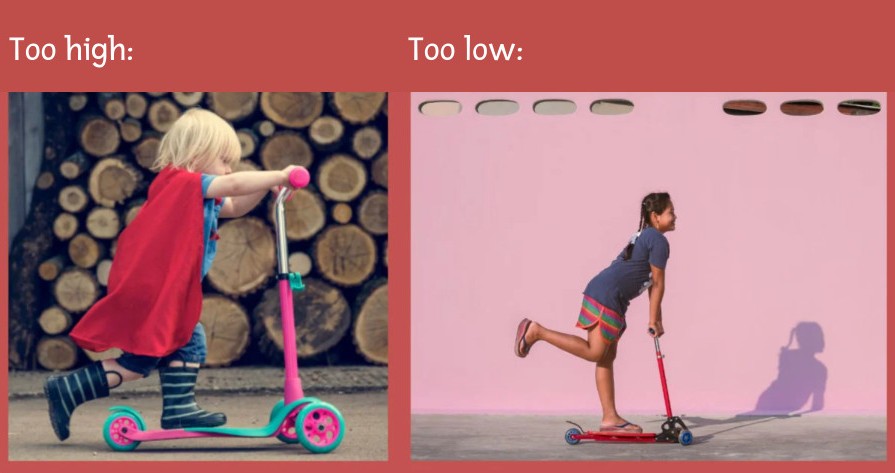
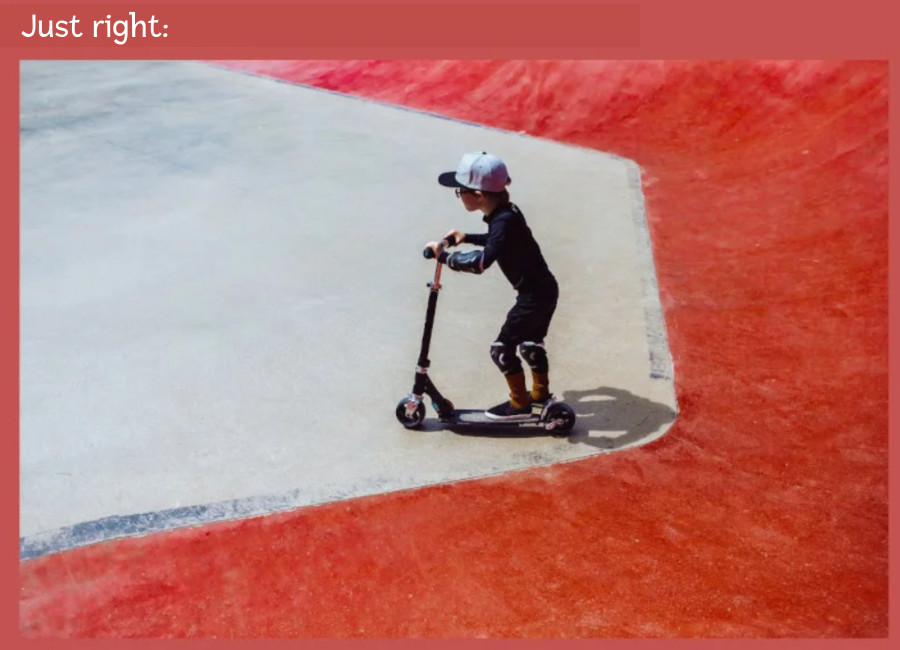
Children’s personal preferences vary when it comes to the most comfortable handlebar height. For this reason, adjustable handlebars are a very convenient choice. That way, you can adjust the handlebars just like your child wants them - and it’ll take longer for your child to outgrow the scooter.
Most, but not all, of our scooters have adjustable handlebars.
Do you definitely want adjustable handlebars? Then bar these models (ba dum tss):
- SR Trickster Scooters
-
Highwaykick 2 (this model is however suitable for children from 89-118 cm)
-
Maui Mini Sharkman
-
My Hood Trick scooters.
The above scooter models do not have adjustable handlebars (but they do offer other advantages).
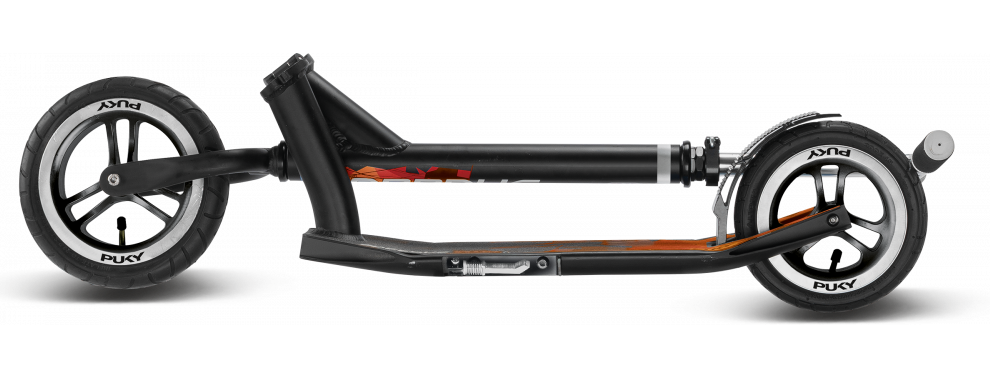
Here are a few good scooter models that your child won’t outgrow for years:
- Our commuter scooter models
- Highwaykick 5 is suitable for children from 118-180 cm, so not for very young children.
- PUKY SpeedUs is suitable for children and adults from 115-200 cm, so also not for the littlest ones.
Foldable or non-foldable scooter?
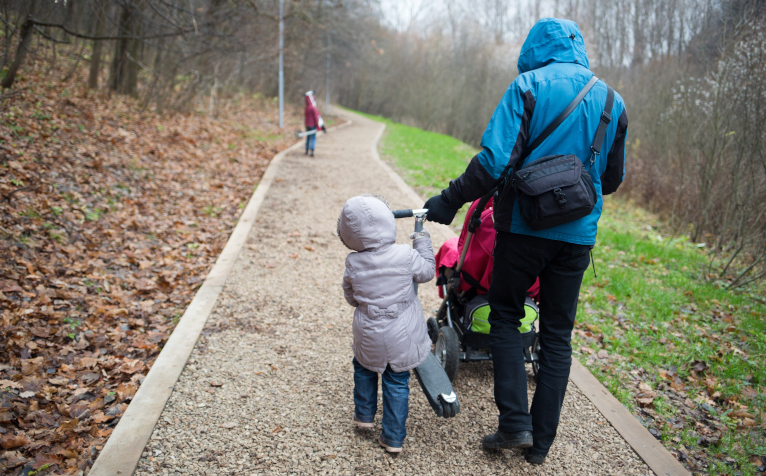
It’s wonderful if your child loves their new scooter and wants to bring it everywhere. But if their little legs suddenly get VERY tired, or if you need to fit the scooter in the trunk of the car (where you also need to make space for the stroller or the pram), being able to fold up the scooter is extremely helpful. The same is true if you don’t want to push around your baby’s pram or stroller with a big scooter lying on top of it - foldable scooters fit in the bottom basket.
We have several foldable scooters in our selection.
Once again, it’s a good idea to filter your search according to your child’s age. That way, you don’t have to scroll past trick scooters for 8–13-year-olds if you’re looking for a scooter for a birthday present for a 4-year-old.
Commuter scooter or trick scooter - what’s the difference?
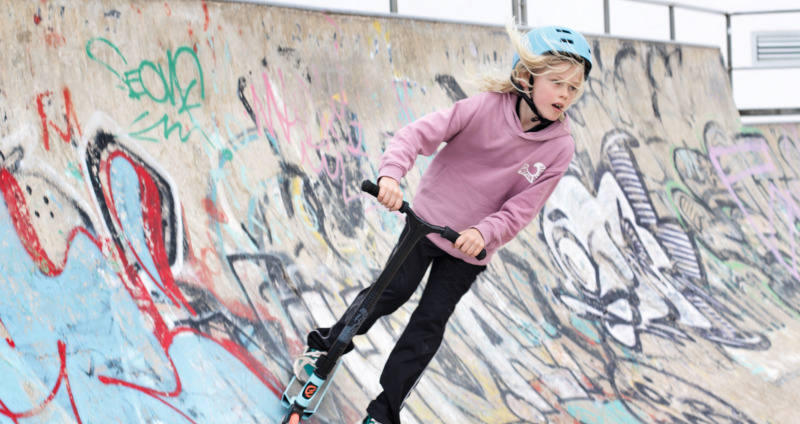
If your child wants to ride their scooter on skate ramps or do tricks like bunny hops, can cans, and whatever else they’re called, we recommend choosing a trick scooter.
A commuter scooter is not suitable for tricks, stunts, and freestyling at the skatepark. Trick scooters are built to handle jumps and falls without getting bent out of shape, but commuter scooters are not designed to withstand the same impact. Remember to regularly tighten the screws and bolts on your child’s trick scooter - all those crooked landings put a lot of strain on the scooter.
Another difference is that trick scooter models tend to be extra narrow for greater flexibility.
However, commuter scooters are more comfortable on longer rides to kindergarten, school, or friends’ houses. Commuter scooters have larger wheels and higher handlebars. They’re designed for decent, steady travel speeds. But your child can certainly use a trick scooter for commuting as well.
Please note that our trick scooters do not have adjustable handlebars. Even so, they will likely fit your child for several years, even as your child grows taller.
Don’t have a skatepark nearby? No problem. You can buy your own ramps here so your child can ride their scooter in the yard or on the playground - a real treat for their gross motor skills, depth perception, and courage.
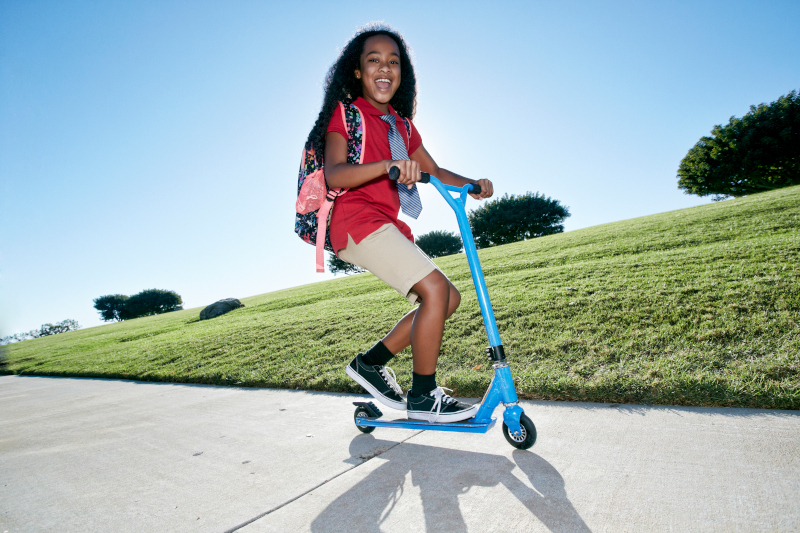
A little tip if your child wants to ride their scooter to school
We're just scooting in with a quick word of advice. It’s about locks.
We’re used to locking our bikes so sticky-fingered thieves don’t sneak off with our trusty steeds. But what about the scooter? It doesn’t come with a lock. And on some of our models, it’s not that easy to squeeze a chain lock through the wheel.
If your child wants to ride to and from kindergarten or school on their new scooter, you may want to choose a model that allows you to fit a cable lock through the wheel. That way, you’ll avoid the sinking feeling of seeing an empty spot where the scooter used to be. With a cable lock, you can lock the scooter to a bike rack or a similar anchor point.
Two or three wheels?
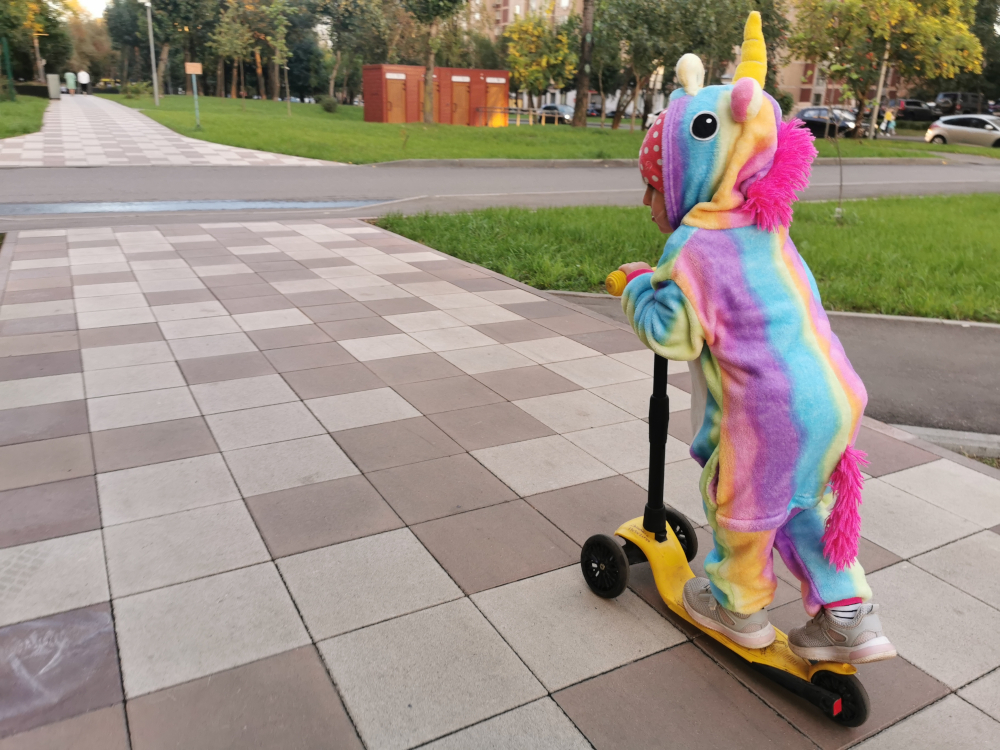
Three-wheeled scooters offer extra stability. That can be a really great thing if your child is a beginner and feels more comfortable on a scooter that doesn’t feel too wobbly. At Toy Academy, we carry three-wheel scooters for children of all ages. In fact, our broad selection of three-wheel scooters has the right fit for your 1-year-old as well as your big kid who now, somehow, stands 173 tall.
Furthermore, three-wheeled scooters can stand up on their own without a kickstand, so they don’t have to be left lying around the playground or the front yard, or propped up against the bike rack at school, when they’re not being used. If you’ve ever had to take a giant step over a stray scooter in your driveway while precariously balancing a big load of groceries, you know that features such as three wheels or a kickstand make a difference.
If your child is used to keeping their balance on a three-wheel scooter or a balance bike, you might want to consider whether the time is right to graduate to a two-wheeled scooter. Especially with older kids, who are starting to send longing gazes towards the local skatepark, two wheels are really the way to go.
Speaking of wheels - foam-filled tires or inflatable tires?
It’s pretty much a matter of personal preference whether you choose inflatable tires or foam-filled tires for your child’s scooter.
Foam-filled tires are puncture-proof and practically maintenance-free. You don’t really need to worry about foam-filled tires. But inflatable tires provide better shock absorption when your child rides over curbs or bumps in the road or races down a lumpy-bumpy forest path. They’re more comfortable on longer rides. The downside is that you may get a flat, and then you’ll need to patch it up and inflate the tire or take the scooter to the local bike repair shop.
It’s a bit like pram and stroller wheels. Some swear by solid wheels while others recommend inflatable tires - and some never even noticed what kind of tires were on there, and now the little one has outgrown the stroller. With trick scooters, the choice is already made - all trick scooters have foam-filled tires, because inflatable tires are no good at the skatepark.

At what age is my child ready for their first scooter?
From around 2, little beginner riders can start to experience the feeling of speed and freedom on a scooter.
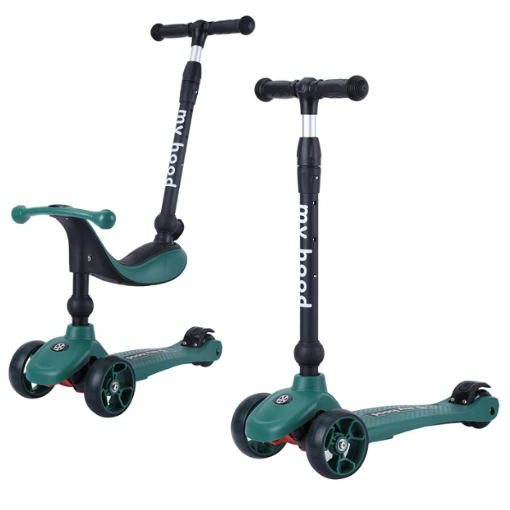
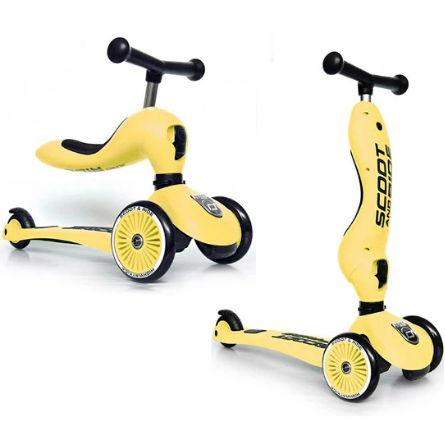
In fact, you can get an early start on balance training about a year before that: we carry multifunctional scooter models which function as both a balance bike and a scooter. On our Kick'n'Ride models, you can attach a parent handle that lets you control your child’s speed and balance - a brilliant idea when tiny legs get tired on the ride home from daycare.
With its wide front wheels, the balance bike rolls along stably and safely. And once your child has had a bit of practice, you can convert the balance bike into a scooter (you don’t even need an Allen key for that). The model is suitable for children from 1-5.
That means your child gets both a scooter and a balance bike in one model. And that means you don’t have to invest in more wheels that take up space in the shed. It’s the perfect solution or gift idea for families with young children.
Traffic safety and kids on scooters - what are the rules?
Where can you ride a scooter?
In some countries, children must ride their scooters on the sidewalk rather than the bike path, regardless of their age and even if they are able to pick up quite a bit of speed.
It may be tempting to race down the bike path right away and not have to slalom between handbags and strollers. And sidewalk pedestrians tend to be less than pleased when a group of scooter tykes zip past them at blazing Tour de France speeds. But before letting your child ride their scooter in traffic, make sure to check and follow your local traffic rules - depending on where you live, your child may have to stick to the sidewalk.
Teach your little speed-lover to be considerate of other road users when they ride to their friend’s house, to school, or to handball practice. Your neighbors will thank you for it. And you can feel calmer when your child goes out and gets some fresh air on their scooter.
Depending on your local traffic laws, your child may not be legally required to wear a helmet on their scooter. But bear in mind that children can really pick up speed once they figure out how to balance. It’s always best to wear a helmet.
It’s also a good idea to get your child into the habit of using knee and elbow pads and wrist guards when they zoom about on their new trick or commuter scooter. When your child starts going fast, and maybe even doing jumps and stunts, it’s better to be on the safe side. Wrist guards in particular are likely to save you a call to the emergency room after a fall. We carry three sizes of wrist guards, suitable for children from age 3 to teens/adults.
Does your child ride their scooter during the dark winter months? In that case, a reflective vest and bike lights on the scooter are essential for keeping your child visible in the dark.
Psst: Special rules often apply to electric scooters:
Your country may have legal age limits for riding electric scooters, including rules for minimum rider age and parental supervision.
In most countries, electric scooters must go on the bike path and wearing a helmet is mandatory by law. As with regular scooters, always check and follow your local rules.
All this talk about speed - does a scooter have brakes?
Most of our children's scooters have brakes, but not all of them.
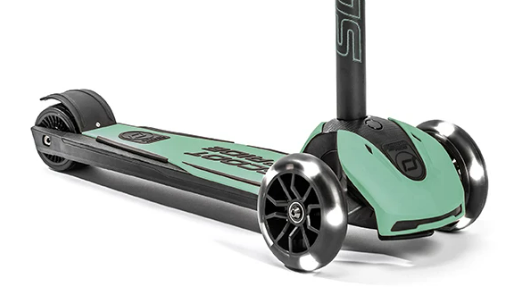
The brake sits like a fender over the rear wheel. It prevents your child’s foot from making contact with the rear wheel while riding and also lets your child stop the scooter by stepping on the brake fender. When pressure is applied to the brake fender, the scooter slows down due to the friction - kind of like when your bike’s fender gets warped and starts to rub against the wheel.
With most of our scooters, you’ll be able to tell from the pictures whether the scooter has a brake on the rear wheel, because you can see the fender. The product description will also tell you whether each model has brakes.
One of our models has a handbrake - just like a bike.
How do I teach my child about road safety?
Start practising traffic safety with your child at home in the yard, in your driveway, at the playground, or even in your living room.
You can use whatever you have lying around, like stones, boots, or buckets, to build a fun slalom obstacle course. Our cones are also great for this!
Maneuvering around obstacles or going up and down ramps are excellent activities for training your child’s motor skills - and for teaching them to assess risks and consequences related to speed and traffic.
Have you practised crossing the street with your kid and paying attention to red and green lights? Traffic games where you play out different scenarios and practise recognising traffic signs help make your child more independent. Our toy traffic signs are great for teaching your child about road safety, and they're fun to maneuver around.
Tip: Have a look around your local area. Maybe there’s even a traffic-themed playground nearby.
Thanks for reading.
We hope this guide answered some of your questions about scooters and that it will help you choose the right one for your child.
If you still have questions, don’t hesitate to reach out. Our customer service agents are ready with friendly further guidance.